Toolkits
Motif: origins and development
The toolkit, its place in UNIX desktops, and the distinction between Motif, Open Motif and LessTif.
Motif's library is libXm: the widgets used to construct menus, dialogs,
text fields and other application controls.
The toolkit sits on Xt and Xlib. Its window manager, mwm, is a
separate program.
What Motif looks like
This small application uses XmLabel, XmPushButton and XmRowColumn.
Motif draws the raised button borders and keyboard-focus indication; Xt provides
resource handling and event dispatch underneath them.
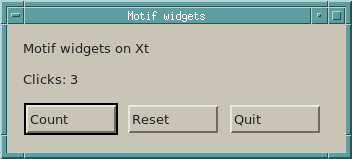
Download motif-counter.c. With Motif, Xt and Xlib development files installed:
cc -std=c99 -Wall -Wextra -o motif-counter motif-counter.c -lXm -lXt -lX11
./motif-counterCount, Reset and Quit use activation callbacks, so the buttons work
with the keyboard as well as the mouse. The status label uses an XmString;
the example frees its temporary string after setting the label resource.
A shared interface for UNIX applications
Motif emerged from the Open Software Foundation's work on a common UNIX software environment. The Open Group's historical timeline records OSF's formation in 1988 and the shipment of Motif 1.0 in 1989. That places it in the workstation era, when applications needed to operate across different vendors' UNIX systems. Source: The Open Group's UNIX timeline
A shared toolkit gave application developers a common set of controls. A style guide addressed how those controls should behave together: menu organisation, dialog conventions and keyboard interaction matter as much as a button's bevel. The Motif programming literature treats interface design alongside the API. Source: Motif Programming Manual
Motif, the window manager and CDE
These related names describe different pieces:
| Name | Role |
|---|---|
libXm | Motif's widget library, linked into applications. |
mwm | The Motif Window Manager, responsible for managing top-level windows. |
UIL and libMrm | A language and runtime facilities for describing and constructing interfaces. |
| CDE | A desktop environment that uses Motif and adds applications and desktop services. |
CDE is an important example of Motif's use. Its own documentation includes an application builder and separate programming, internationalisation and style guides. Sources: CDE overview and CDE documentation.
The Open Group's standards catalogue also records the 1995 Motif Toolkit API specification, C320, and its relationship to CDE. This is useful evidence of Motif's role as an interface standard as well as an implementation. Source: historical standards catalogue
Motif, Open Motif and LessTif
Older instructions use these names in ways that can be confusing. Open Motif belongs to the Motif code lineage. LessTif was an independent implementation intended to provide a compatible, freely available alternative; it was not simply another release of the same source tree.
The LessTif project's own account explains its motivation and identifies Motif's 2012 change to the LGPL as a turning point. The Motif project distributes its source under LGPL terms. When working with an old release, read that release's licence and documentation rather than assuming a later release's terms or behaviour apply. Sources: LessTif project history and Motif project.
Studying Motif through working code
A useful next step is to compare a small example with a larger program. The Motif source distribution contains demonstration programs; CDE provides examples of a complete desktop built around the toolkit. Look for widget construction, resource settings and callback registration before trying to understand every line.
Historical source and documentation are also collected in the archive guide. For a practical introduction, build your first Motif application, then follow the programming resources.